Stop Forcing Roadmaps — Separate Your Work Into Layers
Over the last several projects, I kept running into the same issue:
Roadmaps weren’t actually helping me understand or communicate what was happening.
They were fine for answering:
- When something might happen
- What order things should be built
But they were terrible at capturing:
- how ideas emerge
- how systems evolve
- how organizations actually build capability over time
The problem is that roadmaps try to compress too many different types of work into a single layer.
The Core Problem: Everything Gets Flattened
In most teams, everything ends up in the same system:
- big ideas
- strategy
- features
- implementation work
- tickets
And once that happens, everything gets treated the same.
A half-formed idea sits next to a production bug.
A strategic initiative sits next to a UI tweak.
That’s where things break down.
Because not all work is the same.
Zooming in and out of abstraction
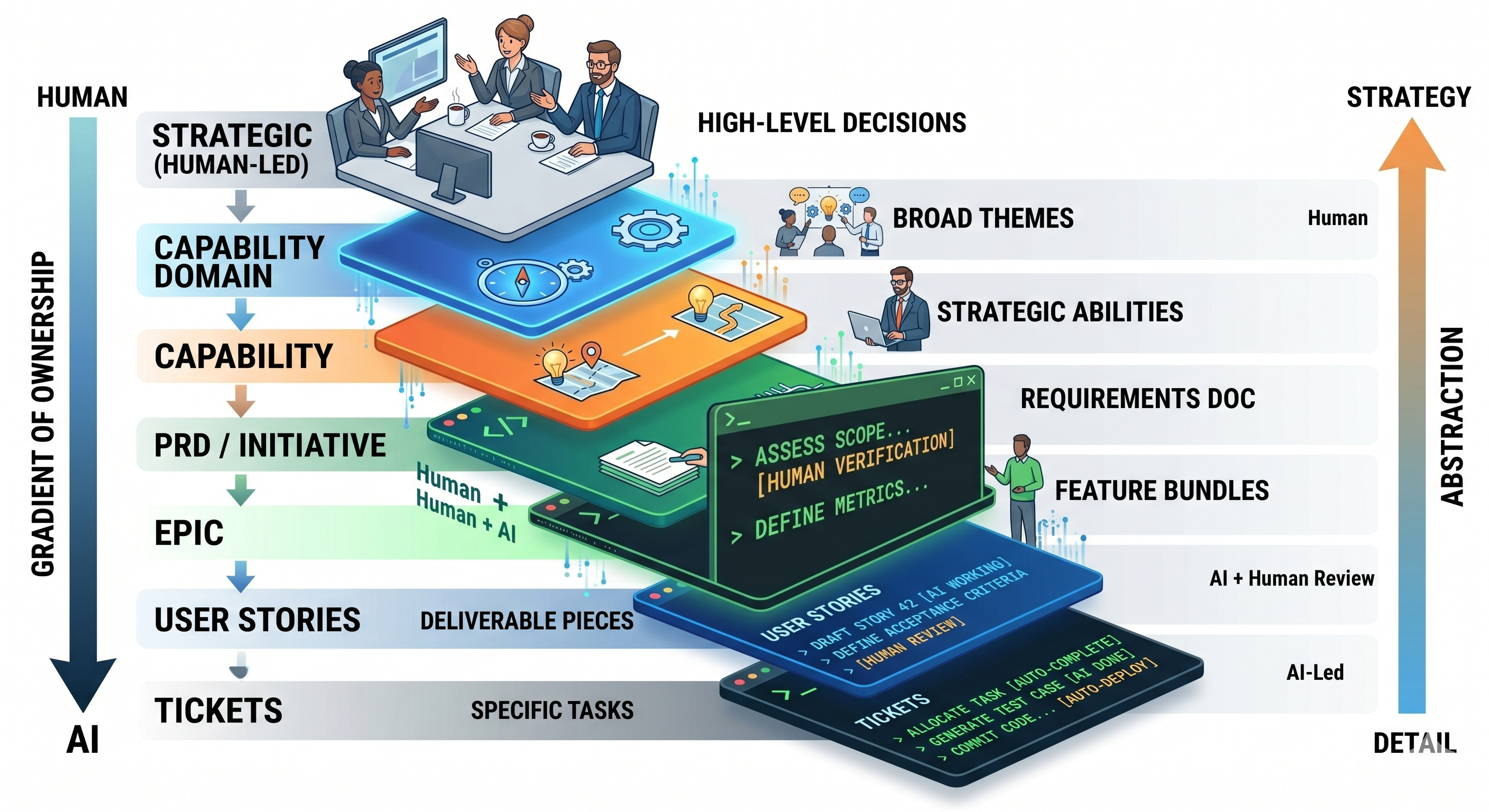
What I’ve found much more useful is separating work into layers:
Capability Domain
↓
Capability
↓
PRD / Initiative
↓
Epic
↓
User Stories
↓
Tickets
Each layer answers a different question.
And more importantly: the higher you go, the more human judgment is required.
Where AI Actually Fits
If you try to introduce AI too high in the stack it can steer you off course.
At the top:
- context is ambiguous
- implications are large
- tradeoffs are complex
That’s human work because we have the context of the full picture, including the years of living and working that are not easily loaded into a copilot agent.
At the bottom:
- problems are well-scoped
- context is clear
- success is measurable
That’s where AI thrives because it can accurately mix the context keep track of thousands of inputs and generate answers rapidly.
Tickets should be thought of as: plans that agents write to each other.
One agent defines the task.
Another refines it.
Another executes it.
Another evaluates it.
Execution becomes scalable.
The Gradient of Ownership
Capability Domain → Human
Capability → Human
PRD → Human + AI assist
Epic → Human + AI
Stories → AI + human review
Tickets → AI
This creates a clean separation:
- humans drive direction
- AI drives execution
Why This Works
This model:
- preserves strategy
- enables AI
- improves clarity
- reflects how organizations actually evolve
Instead of asking: “What do we build next?”
You ask: “What capability do we unlock next?”
That’s a much better question.
Final Thought
Roadmaps aren’t wrong but they don’t capture how we actually generate and prioritize work.
Once you separate work into layers, everything becomes clearer:
- strategy
- execution
- ownership
- and where AI actually belongs