Readiness Levels: A Product-Centric Update
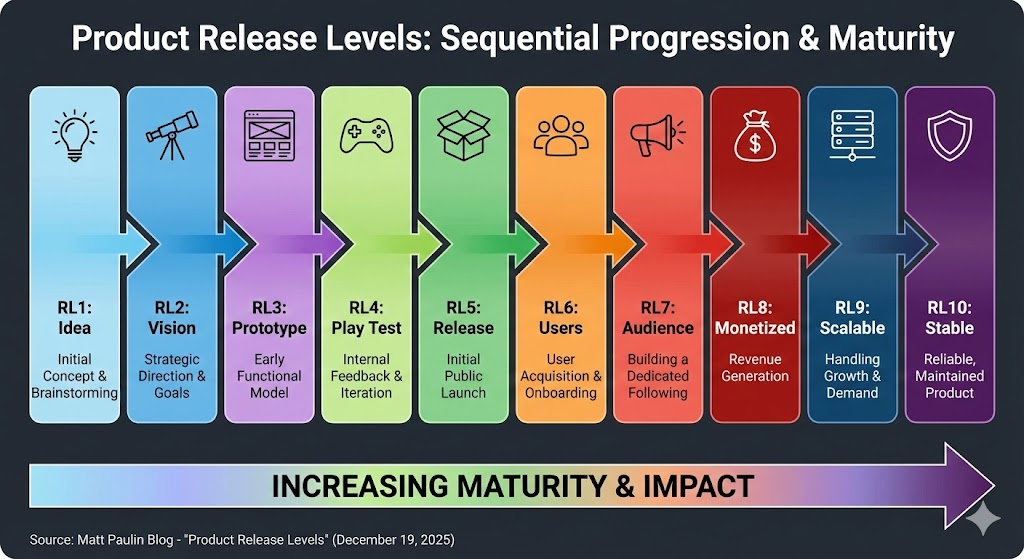 Readiness Levels are a shorthand for describing how mature a product is and what level of commitment it represents.
Earlier versions of this framework were influenced by engineering perspectives and were useful for discussing quality, robustness, and completeness. Over time, it became clear that the same structure could be more effective if reframed around product reality rather than technical execution.
This article updates the Readiness Levels to focus on product readiness while keeping the existing level names intact.
What Readiness Levels Measure
In this version of the framework, Readiness Levels measure:
- How real the product is in the world
- How much commitment has been made
- How reversible decisions still are
- How much risk and expectation exist
They do not measure polish, perfection, or technical quality in isolation.
At each level, something observable becomes true that was not true before.
The Updated Readiness Levels
RL1 — Idea
The idea exists and can be communicated clearly.
There is no commitment, no dependency, and no cost beyond initial thinking. The idea can be abandoned without consequence.
RL2 — Vision
The idea has direction.
There is a defined problem, an intended user, and a basic articulation of why the product might matter. Tradeoffs begin to appear, but the work is still inexpensive to discard.
RL3 — Prototype
The idea has been experienced.
A prototype, demo, or walkthrough exists that allows someone to interact with the concept. The purpose is learning, not correctness or completeness. Real effort has been invested, and some risk is now present.
RL4 — Play Test
The product has been used by people outside the core team.
Feedback is based on observed behavior rather than opinion. Friction and misunderstanding become visible. This level determines whether the product is worth continued investment.
RL5 — Release
The product is publicly available.
There is now reputation risk and an expectation of basic reliability. The product can no longer be treated as an internal experiment.
RL6 — Users
The product is used repeatedly.
Users return intentionally. There is a clear sense of who the product is for and why it provides value. Usage is no longer incidental.
RL7 — Audience
Growth patterns are understood.
There is clarity around how users discover the product and why adoption spreads. Growth may be limited, but it is explainable rather than accidental.
RL8 — Monetized
Economic behavior is measurable.
Revenue, cost savings, or other financial signals are observable. Product decisions now have direct economic implications, even if the model is still being refined.
RL9 — Scalable
The product and organization can grow together.
Increased usage does not disproportionately increase operational burden. Systems, processes, and decision-making scale in a predictable way.
RL10 — Stable
The product is durable.
It sustains itself under normal operating conditions and can evolve without constant restructuring. The product functions as a long-term asset rather than an ongoing experiment.
Why the Names Remain the Same
The level names were intentionally preserved.
They match how teams naturally describe products and allow for quick alignment without additional explanation. The update is in the definition of progress, not the vocabulary.
Relationship to Big Slice / Small Slice (BSSS)
These Readiness Levels align with the Big Slice / Small Slice ownership model:
- Big Slices are associated with advancement in readiness
- Ownership is earned when the product meaningfully progresses
- Contribution is tied to making the product more real, not to activity alone
Readiness describes where the product is.
BSSS accounts for who contributed to reaching that point.
Summary
This update reframes Readiness Levels as a product tool rather than an engineering maturity scale.
The goal is to support clearer planning, better expectation-setting, and more accurate attribution of work as a product moves from idea to stable asset.
Readiness Levels are not a measure of ambition or quality.
They are a shared language for understanding commitment and reality.